
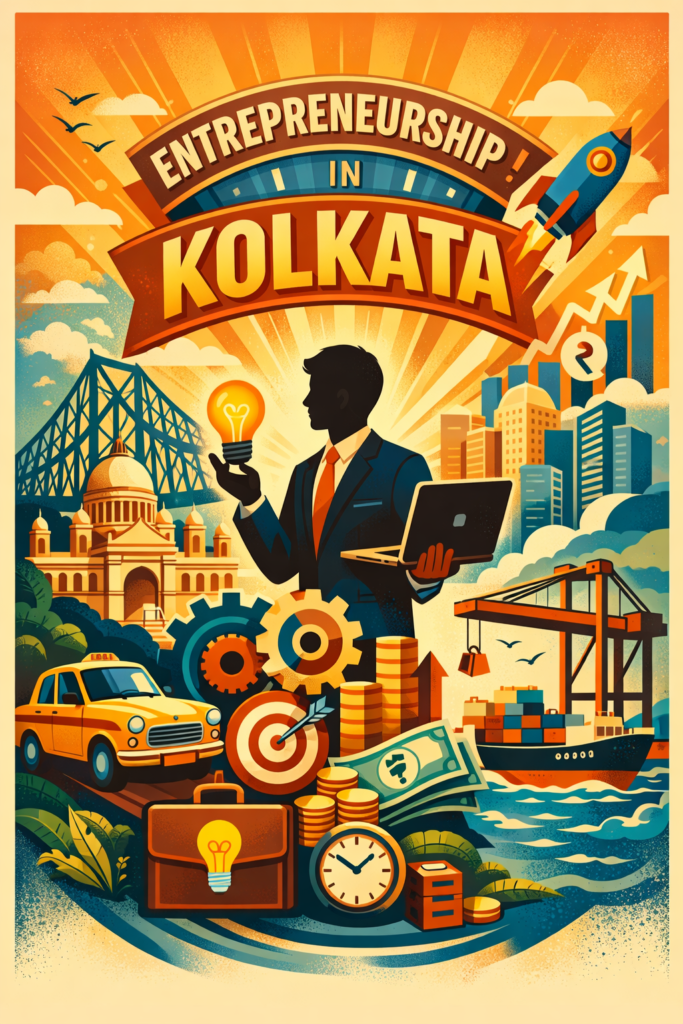
Entrepreneurship has always been part of Kolkata’s DNA. From the trading houses of the 19th century to the intellectual movements of the 20th century, the city has contributed immensely to India’s economic and cultural landscape. Yet today, many business leaders, investors, and young professionals are asking an important question: Does entrepreneurship in Kolkata need a revival today? According to Harsh Goenka and Economic Times, the concept of decay of Kolkata might be a myth.
The answer is not as simple as yes or no. But one thing is clear—entrepreneurship in Kolkata stands at a crucial crossroads.
A Glorious Entrepreneurial Past
Historically, Kolkata was one of the most important commercial hubs in Asia. As the capital of British India until 1911, it became home to major trading companies, jute mills, tea exporters, and banking institutions. Iconic industrial families such as the Birlas and Tatas established significant operations here. The city’s port connected India to global markets, making it a powerhouse of commerce.
Beyond industry, Kolkata produced thinkers, reformers, and risk-takers who shaped modern India. Institutions like Indian Statistical Institute and Indian Institute of Management Calcutta reinforced the city’s intellectual strength. In many ways, entrepreneurship in Kolkata was not just about business—it was about ideas, leadership, and nation-building.
The Slowdown: What Changed?
Over the past few decades, however, Kolkata lost its edge as India’s entrepreneurial capital. Cities like Bengaluru, Mumbai, and Hyderabad surged ahead with booming startup ecosystems, venture capital networks, and tech innovation.
Several factors contributed to this shift:
- Industrial stagnation in the late 20th century.
- Migration of talent to other metro cities.
- Limited venture capital presence in Eastern India.
- Risk-averse mindset among many traditional business communities.
As a result, entrepreneurship in Kolkata began to be associated more with traditional family-run businesses rather than high-growth startups or disruptive innovation.
The Current Scenario: Signs of Change in Kolkata
Despite the challenges, the narrative is not entirely pessimistic. In recent years, entrepreneurship in Kolkata has shown promising signs of revival.
The growth of IT parks in Salt Lake Sector V and New Town has created new opportunities. Young founders are launching startups in fintech, edtech, digital marketing, D2C brands, and consulting. Co-working spaces are expanding. Angel networks are slowly forming. Government initiatives aimed at promoting MSMEs and startups are also gaining momentum.
Moreover, the cost of living and operational expenses in Kolkata remain significantly lower compared to cities like Bengaluru or Mumbai. This offers a competitive advantage for bootstrapped startups and service-based businesses.
In fact, entrepreneurship in Kolkata today is quieter but more diverse than before. Instead of heavy industries, we now see knowledge-driven businesses, creative agencies, consultants, and digital entrepreneurs emerging across the city.
The Mindset Challenge in Kolkata
If there is one area where entrepreneurship in Kolkata needs a revival, it is mindset.
For decades, the most common aspiration among middle-class families was securing a stable government or corporate job. Entrepreneurship was often viewed as risky or unstable. While this mindset is gradually changing, it still influences career decisions.
However, the global economy is shifting. The gig economy, remote work culture, and digital platforms have lowered barriers to entry. Today, a founder in Kolkata can serve clients in the US, Suriname, Dubai, or Singapore without leaving the city. Geography is no longer a limitation.
What entrepreneurship in Kolkata needs now is confidence—confidence to think bigger, scale faster, and compete globally.
The Opportunity Ahead
Kolkata has unique strengths that can fuel a strong entrepreneurial comeback:
- Intellectual capital – The city produces thousands of engineers, MBAs, designers, and data analysts every year.
- Creative culture – Literature, art, cinema, and storytelling are deeply embedded in its identity.
- Strategic location – As the gateway to Northeast India, Bangladesh, and Southeast Asia, Kolkata can become a regional trade hub again.
- Lower operational costs – Affordable office space and talent compared to other metros.
If properly leveraged, entrepreneurship in Kolkata can evolve into a powerful ecosystem focused on consulting, exports, digital services, manufacturing clusters, and cross-border trade.
What Needs to Be Done?
To truly revive entrepreneurship in Kolkata, multiple stakeholders must act:
1. Stronger Investor Ecosystem
Angel investors and venture capital firms need to focus more on Eastern India. Local capital creates local confidence.
2. University–Startup Collaboration
Institutions must encourage students to build startups rather than only seek placements.
3. Policy Support
Simplified compliance, easier funding access, and better infrastructure can accelerate new ventures.
4. Success Stories and Role Models
Nothing inspires entrepreneurs more than visible success. Highlighting local founders who have scaled nationally or internationally can shift public perception.
A New Definition of Revival
Revival does not mean returning to the old industrial model. The future of entrepreneurship in Kolkata will likely look very different from its past.
It will be:
- Digital-first
- Globally connected
- Knowledge-driven
- Service-oriented
- Export-focused
Rather than competing head-on with Bengaluru’s tech ecosystem, Kolkata can carve out its own niche—perhaps as a hub for consulting, creative industries, trade, and cross-border business with emerging markets.
Conclusion
So, does entrepreneurship in Kolkata need a revival today?
Yes—but not because it is dead. It needs revival because it has untapped potential. It needs renewed ambition, stronger ecosystems, and a mindset shift.
The city that once led India’s intellectual and commercial movements still has the talent, heritage, and strategic advantage to rise again. If entrepreneurs, investors, institutions, and policymakers align their efforts, entrepreneurship in Kolkata can transform from a quiet undercurrent into a powerful wave of innovation and growth.